

ADVERTISEMENT:

Search for a story:
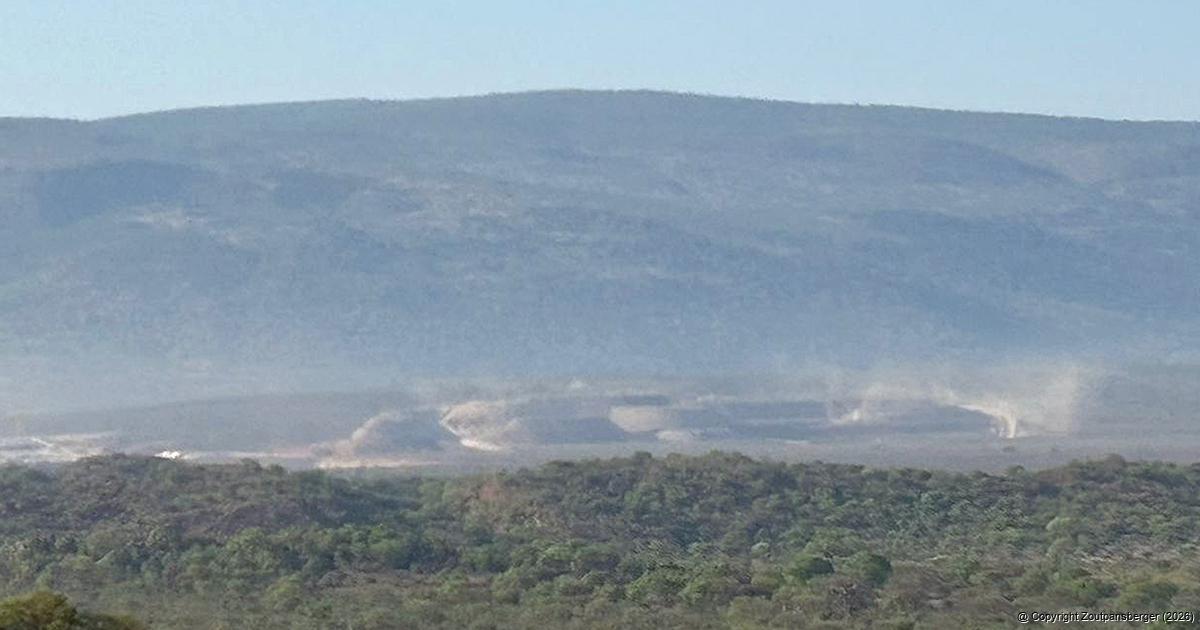
As dust clouds rise amid increased mining activities at MC Mining’s Makhado Project in the background, the controversy surrounding the mine remains far from settled. Photo supplied.
MC Mining pushes for production despite persistent 'illegal mining' claims
Date: 07 November 2025 By: Andries van Zyl
MC Mining’s announcement last week that activities for a coal-handling and -preparation plant (CHPP) at their Makhado Project, just north of the Soutpansberg, will begin by December 2025 has sparked fierce criticism from environmental groups and the Democratic Alliance (DA) alike.
The announcement accompanied the release of MC Mining’s quarterly activities report for the period ended 30 September 2025. The report highlights the “milestones” achieved at the Makhado Project, a steelmaking hard-coking coal (HCC) venture 67% owned by MC Mining. The project, the company said, was set to become South Africa’s largest HCC producer, targeting 800,000 tonnes a year once the foundation phase reached steady-state operation over its planned 28-year life-of-mine.
The mine also intends to supply the Chinese-based Kinetic Development Group Limited’s (KDG) planned ferrochrome smelter within the Musina-Makhado Special Economic Zone (MMSEZ). Earlier this year, KDG acquired a 51% controlling stake in MC Mining.
MC Mining on track to start mining
The report, issued on Friday, 31 October, confirmed that open-pit mining of the box cut has commenced, with coal exposure expected by November 2025. Civil foundational works are largely complete, with attention now shifting to steelwork, mechanical and equipment installations. Construction of the main power supply line, the 14 km Paradise Overhead Line (OHL), is progressing well and remains on schedule for completion in December.
On regulatory and environmental compliance, MC Mining emphasises that the project has maintained “excellent” performance across safety, health, environmental, and regulatory metrics. The company said the project’s pollution prevention plan and greenhouse gas emissions report had been approved by the Department of Forestry, Fisheries and the Environment. MC Mining saw this as further proof of the project’s environmental credentials and confirmed that the Department of Mineral and Petroleum Resources (DMPR) had conducted a comprehensive, multi-discipline onsite audit covering health, safety, environmental, social, and regulatory compliance.
Claims of “illegal” mining activities
Yet despite these assurances, the company’s readiness to start production next month has reignited backlash, with critics alleging that MC Mining is engaging in “illegal mining.”
The DA, through its national spokesperson for Forestry, Fisheries and Environment, Andrew de Blocq MP, issued a statement on 22 August accusing MC Mining of illegal mining at the Makhado Project linked to the MMSEZ. The DA called on Mineral and Petroleum Resources Minister Gwede Mantashe to take urgent action, claiming the company began open-pit mining despite its environmental authorisation being suspended and under appeal. On the nature of these claims, De Blocq stated that MC Mining’s environmental authorisation had been suspended and was under appeal in the North Gauteng High Court, rendering it invalid.
De Blocq warned that mining within the Vhembe Biosphere Reserve carried severe environmental and financial risks, citing MC Mining’s history of non-compliance and fragile finances, which could leave taxpayers liable for rehabilitation costs. The DA also criticised the Limpopo government for supporting “foreign polluters” over sustainable local development, pledging instead to promote lawful, environmentally responsible economic growth.
MC Mining defends lawful operations
Responding to the newspaper's media enquiry on 25 August 2025, MC Mining strongly denied the DA’s claims, asserting that its subsidiary, Baobab Mining and Exploration (Pty) Ltd, operates fully within South Africa’s regulatory framework. Company spokesperson Andrew Modise said the environmental authorisation remained valid, as confirmed by the Minister of Mineral and Petroleum Resources, and noted that pending court processes did not affect the legality of current operations.
Modise added that financial guarantees for rehabilitation and closure were in place, all permits were valid, and MC Mining remained committed to environmental sustainability and compliance. He dismissed the DA’s allegations as baseless and damaging to investor confidence, reaffirming the company’s support for government industrial plans and cooperation with any official investigations.
DA reaffirms “illegal mining” claim
De Blocq told the newspaper on Tuesday that the DA still considered MC Mining’s activities illegal, as nothing had changed regarding the appeals process.
“I have seen nothing from MC Mining or from the department that refutes the fact that their environmental authorisation is invalid as long as there is an appeal underway against it. I have seen no legal opinion. I have seen no logical reasoning to suggest otherwise. So, as far as I am concerned, by my reading of the law and the letter of the law, they do not have environmental authorisation to be doing what they are doing, and they have openly admitted that they have broken ground and that they are commencing mining activities,” said De Blocq.
Environmental group raises concerns
One of the most vocal environmental groups on the issue, Living Limpopo, echoed these concerns.
“The contrast between MC Mining's reported environmental regulatory compliance and the facts, not least that environmental authorisation for Makhado Colliery remains suspended pending an appeal decision before the Minister of Forestry, Fisheries and the Environment, is what concerns us. We would be very eager to see the results of the reported DMPR compliance audit, given the indisputable status of the appeal. The further approvals have been granted without our knowledge or participation,” said Living Limpopo spokesperson Lauren Liebenberg.
Liebenberg criticised MC Mining’s relationship with local stakeholders as far from collaborative. “What remains consistent are the gross irregularities perpetrated by both MC Mining and its parent, the Kinetic Development Group, in the development of their coal mine, coking coal, and ferrochrome smelter projects in the MMSEZ,” she said.
Water crisis looms
“Our gravest concern now is water,” Liebenberg said. She explained that the approved plan to meet the mine’s vast water requirements from the Nzhelele Dam had never been implemented. “It relied on an agreement with the Nzhelele Irrigation Farmers that was voided years ago. Neither the transfer of the irrigation water allocation nor the infrastructure upgrades intended to yield ‘new water’ have been completed and made available for the mine’s use. So where will the water come from?” she asked.
Liebenberg also cited recent pollution reports. “Already there is evidence of arsenic contamination of the groundwater during construction. Abstracting from the Nzhelele River now, when the catchment is already under stress, would have catastrophic consequences for downstream water users, other economic sectors, and ecosystems,” she said.
Action required immediately
With MC Mining poised to enter production in the coming weeks, Liebenberg warned that urgent action was needed.
“It is critical that this issue be resolved immediately, and not by DMPR. We call upon the Department of Water and Sanitation to act now with the urgency the situation demands. As custodians of our scarce water resources, DWS cannot permit the Makhado Colliery to go into production without confronting the collapse of the Nzhelele water deal and the failure to implement the approved water supply plan. The mine has been built. There is still no water for it to operate. It is as stark as that,” she said.
Liebenberg concluded that until an alternative water source and supporting infrastructure were in place, MC Mining must be compelled to suspend operations. “To rely on the insistence of the mining company, which profits from polluting, that it is fully compliant would be grossly irresponsible. A water crisis can still be averted – and must,” she said.
Viewed: 2573

Andries van Zyl
Andries joined the Zoutpansberger and Limpopo Mirror in April 1993 as a darkroom assistant. Within a couple of months he moved over to the production side of the newspaper and eventually doubled as a reporter. In 1995 he left the newspaper group and travelled overseas for a couple of months. In 1996, Andries rejoined the Zoutpansberger as a reporter. In August 2002, he was appointed as News Editor of the Zoutpansberger, a position he holds until today.
Most Read Articles
Sponsored Content
Recent Headlines