

ADVERTISEMENT:

Search for a story:
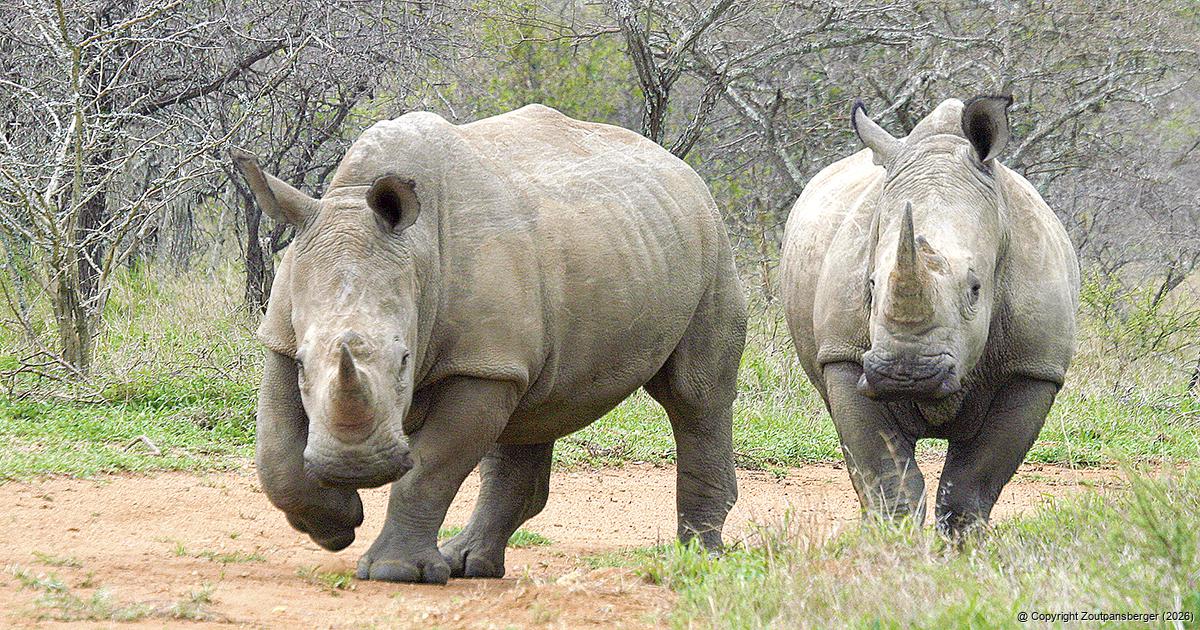
A hard-won victory for rhino breeders: The High Court’s landmark ruling may open the way for the legal sale of sustainably harvested rhino horn from captive-bred animals. Photo: Andries van Zyl.
Court rules in favour of rhino breeder in landmark case
Date: 07 November 2025 By: Andries van Zyl
In a landmark judgment delivered on 31 October 2025, the High Court of South Africa (Northern Cape Division, Kimberley) ruled in favour of rhino conservator Hendrick (Wicus) Diedericks, ordering the provincial environmental authority to reconsider issuing permits for the international trade of sustainably harvested rhino horn.
The ruling could have far-reaching implications for private rhino breeders and conservationists across South Africa. Diedericks, who operates a registered “non-commercial” conservancy for breeding white rhinoceroses, argued that selling horn from living, captive-bred animals was vital to fund protection and feed costs that amount to roughly R20 million a year.
“The effect of this is that the court ruled that a rhino horn originating from a registered captive-bred operation may legally be sold internationally in terms of CITES legislation,” said Hennie Erwee of Erwee Attorneys in Musina, who has long been involved in legal matters relating to rhino horn trade.
A victory for rhinos
“Personally, I think that as far as the rhino moratorium is concerned, this is certainly a victory for rhinos. In my opinion, it will mean that more and more people will apply for registration of captive-bred operations as they will be able to sell their horns for an international price,” Erwee said.
The case turned on a complex point of law: whether Article VII(5) of the Convention on International Trade in Endangered Species of Wild Fauna and Flora (CITES)—which relaxes restrictions for specimens derived from non-commercially bred animals—is part of South African law. Writing for the Court (with Tlaletsi JP concurring), Lever J found that it was.
Authorities applied wrong CITES provisions
The court ruled that CITES had been incorporated into domestic law through the National Environmental Management: Biodiversity Act (NEMBA). It rejected the government’s argument that the Minister had deliberately excluded Article VII (5) as a “stricter domestic measure,” noting that such measures must be expressly set out and registered with the CITES secretariat—something that had not occurred. Because Diedericks’s operation was a captive breeding facility for non-commercial conservation purposes, the court held that the authorities had applied the wrong provisions of CITES, treating his application as if it related to trade in wild animals.
The judgment declared that the Article VII (5) exemption is part of South African domestic law, meaning a certificate from the management authority may replace the need for standard import and export permits. The decision refusing Diedericks’s permits was reviewed and set aside, and the MEC was ordered to take a fresh decision within seven days.
Not the first time courts weigh in on rhino horn trade
This is not the first time the courts have weighed in on South Africa’s controversial rhino-horn trade ban. A national moratorium on domestic sales was imposed in 2009 under NEMBA but later overturned in a landmark 2015 High Court ruling in Kruger and Another v Minister of Water and Environmental Affairs and Others. In that case, brought by Johan Kruger and John Hume, the court found that the government had failed to follow proper public consultation procedures.
“The court found the moratorium unlawful, and trade was then permitted. Rhino poaching decreased slightly, but it became very difficult to obtain permits,” said Erwee. This boosted illegal poaching and trade again.
Erwee drew a comparison with other species. “As we all know, the argument we used in the rhino moratorium case—which we won and in which the State appealed twice and lost both appeals—was that, in the 1950s, there was legislation restricting blesbok to certain provinces. When that legislation was repealed, the population grew, and today there are probably between 300,000 and 400,000 blesbok. So, relaxing legislation ensures the conservation of rhinos,” Erwee said.
Court ruling underscores challenges
Last week’s ruling again underscored the challenges faced by private rhino breeders. “Unfortunately, our government opposes everything and stands against us, and that has caused people like John Hume, who was the world’s largest rhino breeder, to have to sell to African Parks and retire. Hopefully, this will mean that he can sell his stockpile of horns, which I believe amounts to 12 tonnes,” Erwee said.
At one point, Hume was believed to own between 13% and 15% of the world’s white rhino population.
Limited relief for rhino breeders
While the judgment is being hailed as a breakthrough, its scope is limited. It applies only to registered, captive-bred breeders operating on a non-profit basis. “It’s quite a technical point. You can sell the horns at a profit, but the profit is used to cover expenses as a captive-bred operation has very high running costs. Remember, you need armed security, etc. So, if this ruling had come during John’s time, it would have helped him a great deal. I understand, reading between the lines, that the State is going to appeal, and I expect nothing less,” Erwee said.
He urged the government to use the judgment as an opportunity to collaborate with the industry rather than fight it. However, he remains sceptical.
“Long story short—the government needs to stop working against the private sector and start working with it. To do that, they need insight into what they are doing, and that’s where the problem lies,” said Erwee.
Viewed: 1516

Andries van Zyl
Andries joined the Zoutpansberger and Limpopo Mirror in April 1993 as a darkroom assistant. Within a couple of months he moved over to the production side of the newspaper and eventually doubled as a reporter. In 1995 he left the newspaper group and travelled overseas for a couple of months. In 1996, Andries rejoined the Zoutpansberger as a reporter. In August 2002, he was appointed as News Editor of the Zoutpansberger, a position he holds until today.
Most Read Articles
Sponsored Content
Recent Headlines