

ADVERTISEMENT:

Search for a story:
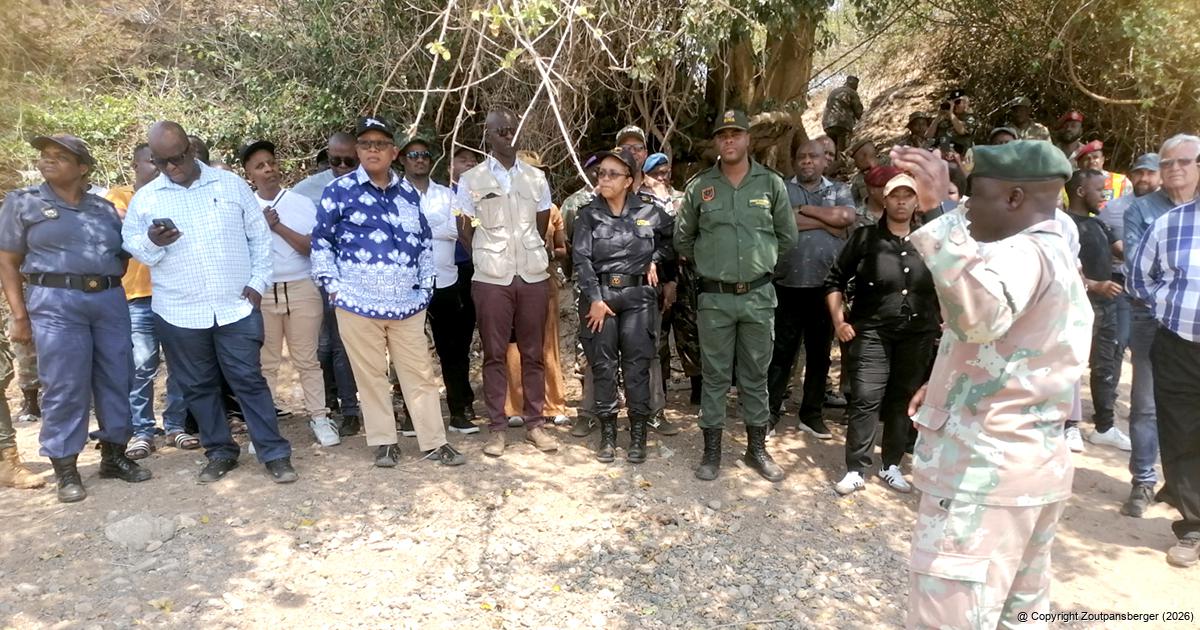
An SANDF member explains to the parliamentarians the challenges the army faces at Gate 2 near Tshirundu village. Photo: Bernard Chiguvare.
SA faces major crisis on northern border
Date: 24 October 2025 By: Bernard Chiguvare
South Africa's border security crisis at Beitbridge has reached a critical flashpoint. A R37 million fence lies in ruins, while just 500 soldiers struggle to patrol more than 1,000 kilometres of porous border, and soldiers deployed to protect the nation are living in conditions so dire, they are forced to bathe in their tents.
These are the harsh realities exposed last week when parliamentary committees visited the country's busiest land border with Zimbabwe, where illegal crossings, smuggling and corruption have turned what should be a secure gateway into what lawmakers are calling a “serious national threat.”
Last week, the Joint Standing Committee on Defence and the Portfolio Committee on Defence and Military Veterans travelled along the border fence to observe some of the hot crime areas. This was an opportunity for the South African National Defence Force (SANDF) and the Border Management Authority (BMA) to explain to the committees why the country's borders remain porous.
Both entities indicated that the lack of an adequate budget and manpower makes it difficult to manage all activities along the border efficiently.
Around 500 soldiers are currently patrolling the 1,178 km stretch of the Beitbridge border. This severely incapacitates the army's border patrols as soldiers struggle to be present at every point at all times. According to Rear-Admiral Prince Tshabalala, this situation makes it difficult for the army to effectively monitor illegal crossings.
Fence in ruins
The R37 million border fence, which stretches for 40 km, is almost completely down, posing another challenge for the army as they cannot man every area all the time because of limited capacity. The fence was originally built in 2020 as a COVID-19 emergency measure but was plagued by irregularities in the contract-awarding process. Courts later ordered contractors to pay back profits, and the Special Investigating Unit found evidence of procurement irregularities and possible fraud.
The current national defence budget is R57 billion, but according to Tshabalala, half of that amount is allocated to salaries.
“For effective monitoring of the border, we need to invest in new technology such as drones to assist us in monitoring every spot at any given time. In addition, the army needs more vehicles to carry out effective patrols along the border,” said Tshabalala.
Despite the challenges, the BMA reported some success during the 2024/25 festive season, with a 215% increase in successfully prevented illegal border crossings, intercepting over 50,000 undocumented persons. A pilot programme using drones at five ports of entry, including Beitbridge, identified 2,326 breaches in the border fence that were then sealed.
Soldiers living in squalor
A few kilometres from the notorious Gate 2, where illegal crossings of goods and people are rife, the newspaper spoke to some female soldiers who expressed concern about their living conditions at their camp.
They said they shared bathrooms with men and often had to bathe inside their tents as the facilities were in poor condition. There is also no electricity at the campsite; they rely on a generator that operates for only two hours before being switched off.
One ageing scanner
In addition to budget and manpower challenges, the Border Management Authority operates with only one ageing cargo scanner, which cannot function 24 hours a day. The scanner is a large X-ray system used to detect contraband such as illegal cigarettes, drugs, weapons and other prohibited goods hidden inside vehicles and containers without requiring physical unpacking. When the scanner is down, there is a free flow of illegal goods.
“We are working with one old scanner that cannot operate around the clock. When the machine is not working, we cannot detect any illicit goods entering the country,” said David Chilembe, BMA Deputy Commissioner.
The scanner at Beitbridge was originally a refurbished mobile unit deployed from Durban in 2015, making it nearly a decade old.
Chilembe also raised concerns about corruption at the border, particularly among reservists who are hired for six months and then released.
“Imagine if such a reservist is bribed — they will accept it, knowing that after six months they will not be earning any income. This is a major challenge for the BMA,” he said.
Corruption remains a persistent problem at the border. Between July 2024 and February 2025, 27 Department of Home Affairs officials were dismissed for offences including fraud, corruption and sexual misconduct, with eight already convicted and sentenced to prison terms ranging from four to 18 years.
Jurisdictional challenges
The BMA, which was introduced in 2022, was established to facilitate the smooth movement of goods across the border and to serve as the sole entity accountable for border management. However, it continues to face challenges in instructing personnel from other government departments.
“Personnel from other entities will always say they report to their immediate supervisors within their departments,” said Chilembe.
The Co-Chairperson of the Joint Standing Committee, Dr Malusi Gigaba, noted the challenges and promised to escalate the matter.
Portfolio Committee on Defence and Military Veterans Chairperson Mr Dakota Legoete also acknowledged the challenges. “There is a serious national threat here at Beitbridge,” he said.
Viewed: 3271

Bernard Chiguvare
Bernard Chiguvare, a Zimbabwean-born journalist, has dedicated his career to social justice reporting. Since 2015, he has contributed to GroundUp, an online publication focused on public interest news, Bernard started writing for Limpopo Mirror in 2019, again focusing on news that highlights the plight of especially poorer communities. In 2025 he was awarded the opportunity to join the Southern African Accountability Journalism Project (SAAJP), an initiative aimed at strengthening investigative journalism within the Southern African Development Community (SADC) region.
Most Read Articles
Sponsored Content
Recent Headlines