

ADVERTISEMENT:

Search for a story:
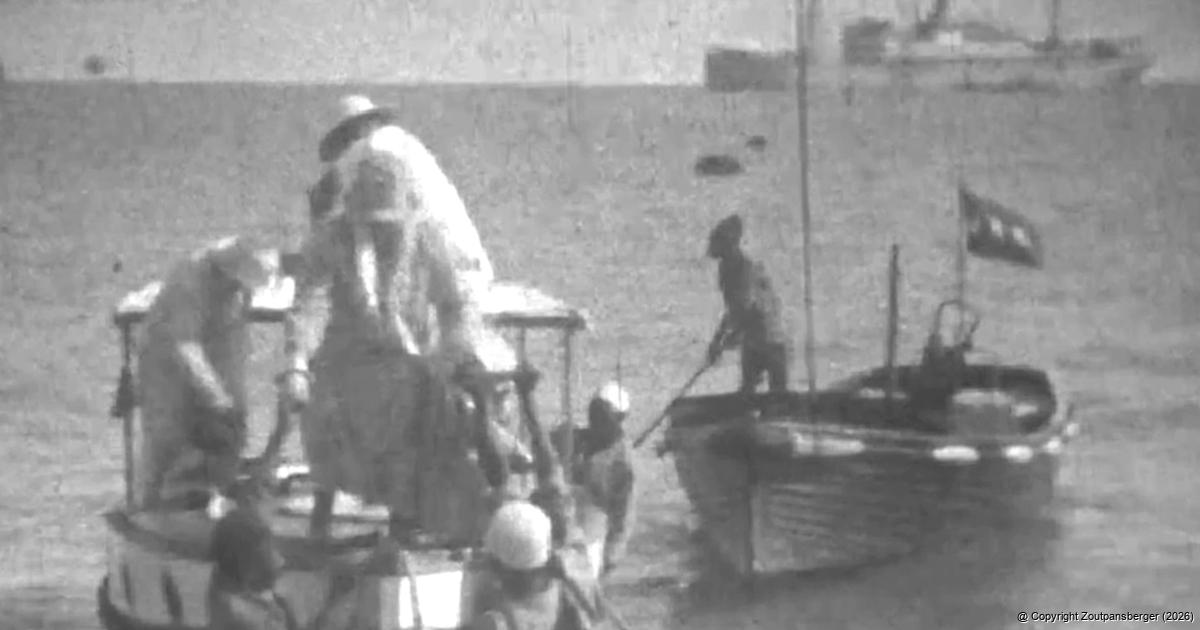
We see the Van den Berg tour party disembarking a small sailing vessels, setting foot on the Zanzibar shoreline with the historic MV Liemba (built in 1913, this ship is the only surviving vessel of the German Imperial Navy still in use today) in the background.
Watch: Oom Willem makes his way into Zanzibar and Kenya
Date: 07 June 2025 By: Andries van Zyl
We continue our “walkabout” this week with the intrepid Oom Willem van den Berg and his almost-100-year-old journey up the East Coast of Africa, all captured on 16mm film and recently digitised. Did you have time to watch our second home movie of Oom Willem’s travels, and do you know where he headed next? If not, let us bring everyone up to speed again.
In our first movie, we saw Oom Willem depart by rail from South Africa, crossing into what was then Rhodesia before heading east into Mozambique. From there, the tour party swapped rail travel for seafaring, making their way up the East Coast of Africa to Dar es Salaam. Along the way, we joined Oom Willem in visiting several historic and interesting sites. The first home movie concludes with the travellers back on a ferry, continuing north from Dar es Salaam.
This brings us to our second home movie instalment. Around 13 seconds in, we see the Van den Berg tour party disembarking from a small sailing vessel, setting foot on the Zanzibar shoreline, with the historic MV Liemba (built in 1913—the only surviving vessel of the German Imperial Navy still in use today) in the background.
After familiarising themselves with the lay of the land, Oom Willem’s group is seen in front of a building (timestamp 0:01:36) where a group of people and sacks—possibly of spices—are depicted. Zanzibar is often called the “Spice Island” for its long history as a major producer of spices such as cloves, cinnamon, nutmeg and pepper. The sacks suggest ongoing trade activity in the area. The building is typical of the architecture found in historic trading centres such as Stone Town in Zanzibar.
The next historic landmark seen in the home movie is the Sultan’s Palace (0:01:56), also known as Beit el-Sahel, located on the seafront of Stone Town. It was constructed in the late 19th century during the reign of Sultan Said Barghash and served as the royal residence for the sultans of Zanzibar. The palace was built after the original royal palace was destroyed during the Anglo-Zanzibar War of 1896—the shortest war in history, lasting between 38 and 45 minutes. Today, the Sultan’s Palace stands as a prominent landmark, reflecting Zanzibar’s rich history of Omani Arab influence, colonial encounters and cultural heritage.
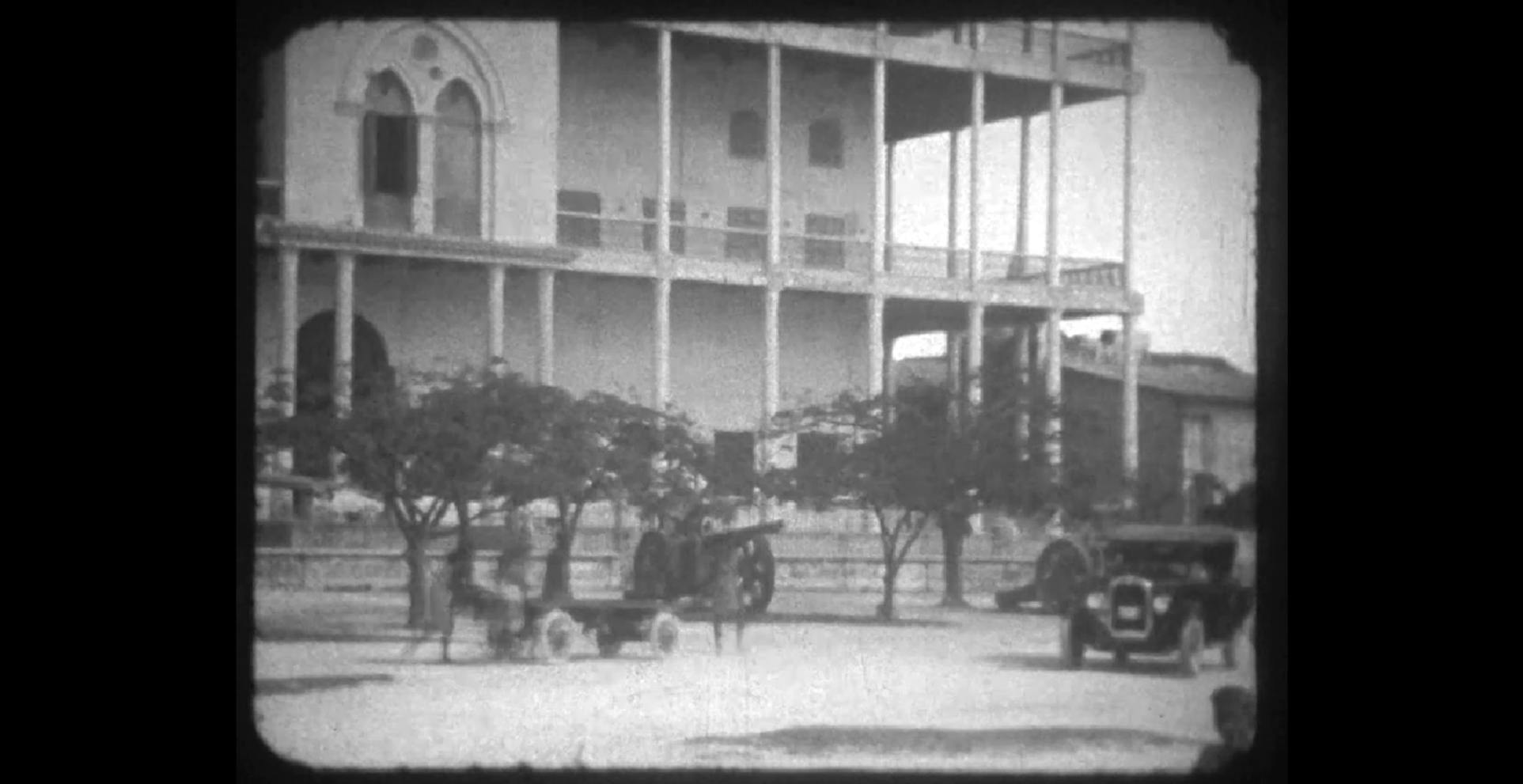 |
| The Sultan's Palace, also known as the Beit el-Sahel, located on the seafront of Stone Town. |
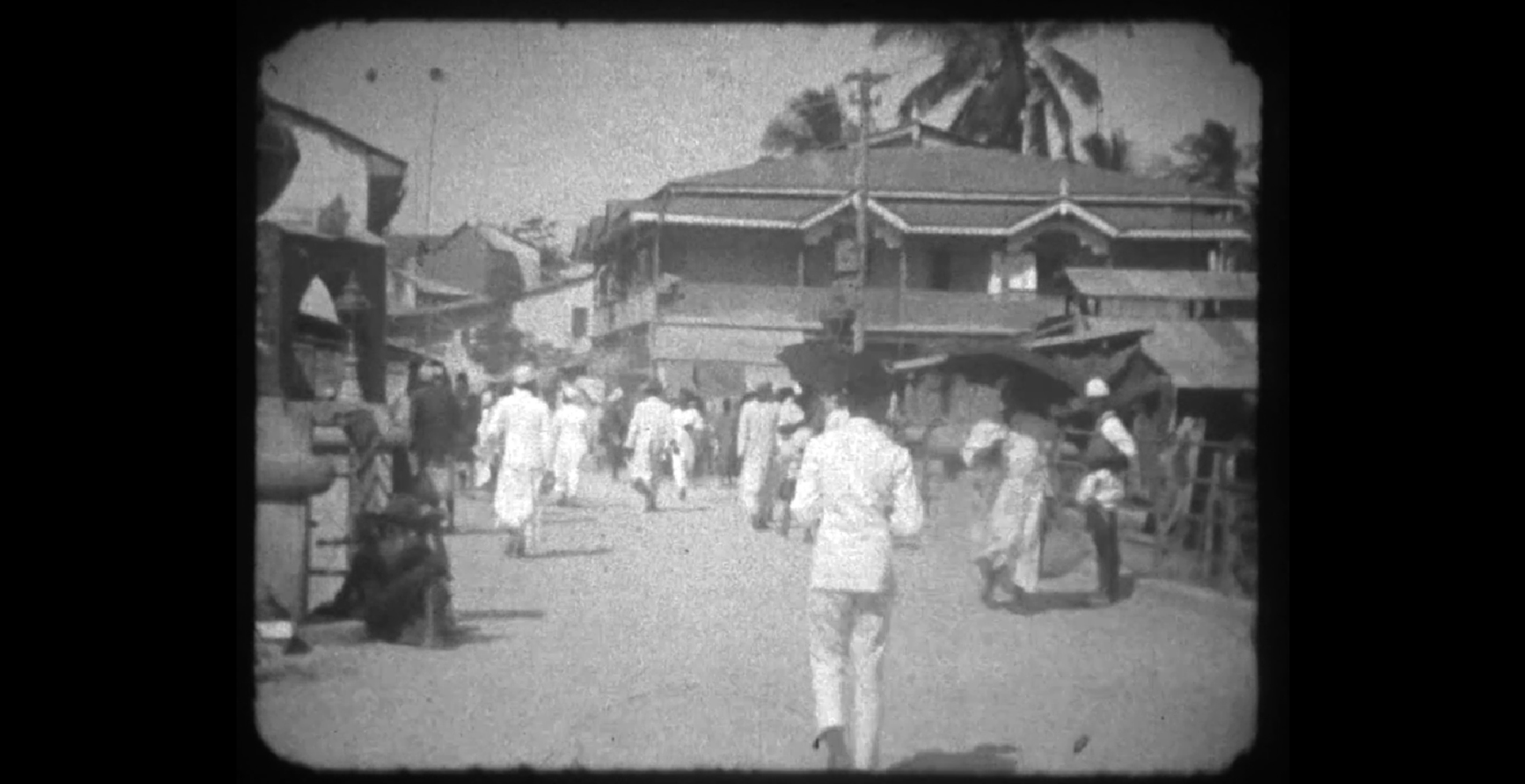
At the 0:02:17 mark, the Van den Berg tour takes viewers to what appears to be a nondescript location, but which turns out to be the historically significant Darajani Bridge. This bridge connected Stone Town with the main island and played a crucial role in the city's development, particularly before the construction of paved roads. Before its construction, Stone Town was partially isolated by a tidal creek. The original wooden bridge was replaced with a new one, opened in 1917 by the British Resident, J.H. Sinclair, and designed by the Director of Public Works, Mr Crawley. The Swahili word Darajani means “bridge,” highlighting its importance.
 |
|
The Van den Berg tour takes viewers on a visit to what seems to be a nondescript location, which actually turned out to be a most significant historic bridge. The scene is actually of the Darajani Bridge. |
A visit to the Stone Town market was certainly on the cards for the Van den Berg party as can be seen at timestamp 0:02:34. This scene depicts the Stone Town area, a UNESCO World Heritage Site. The architectural style visible in the background—coral stone buildings with distinct wooden balconies and intricately carved doors—is typical of Stone Town. The bustling crowd in the foreground, many dressed in traditional attire, offers a glimpse into the social and cultural life of the era.
Also on the itinerary was a visit to the Peace Memorial Museum (0:02:50), also known as Beit el Amani. Built in 1925, it was designed by British architect J.H. Sinclair as a memorial to the peace accords that ended the First World War. The museum originally housed exhibits on Zanzibar's history, slavery, archaeology and traditional crafts. These exhibits have since been relocated to the developing museum at the House of Wonders, and the building now functions as a library.
 |
|
Also on the tour itinerary was a visit to the Peace Memorial Museum, also known as Beit el Amani. It has its history rooted in the end of the First World War. |
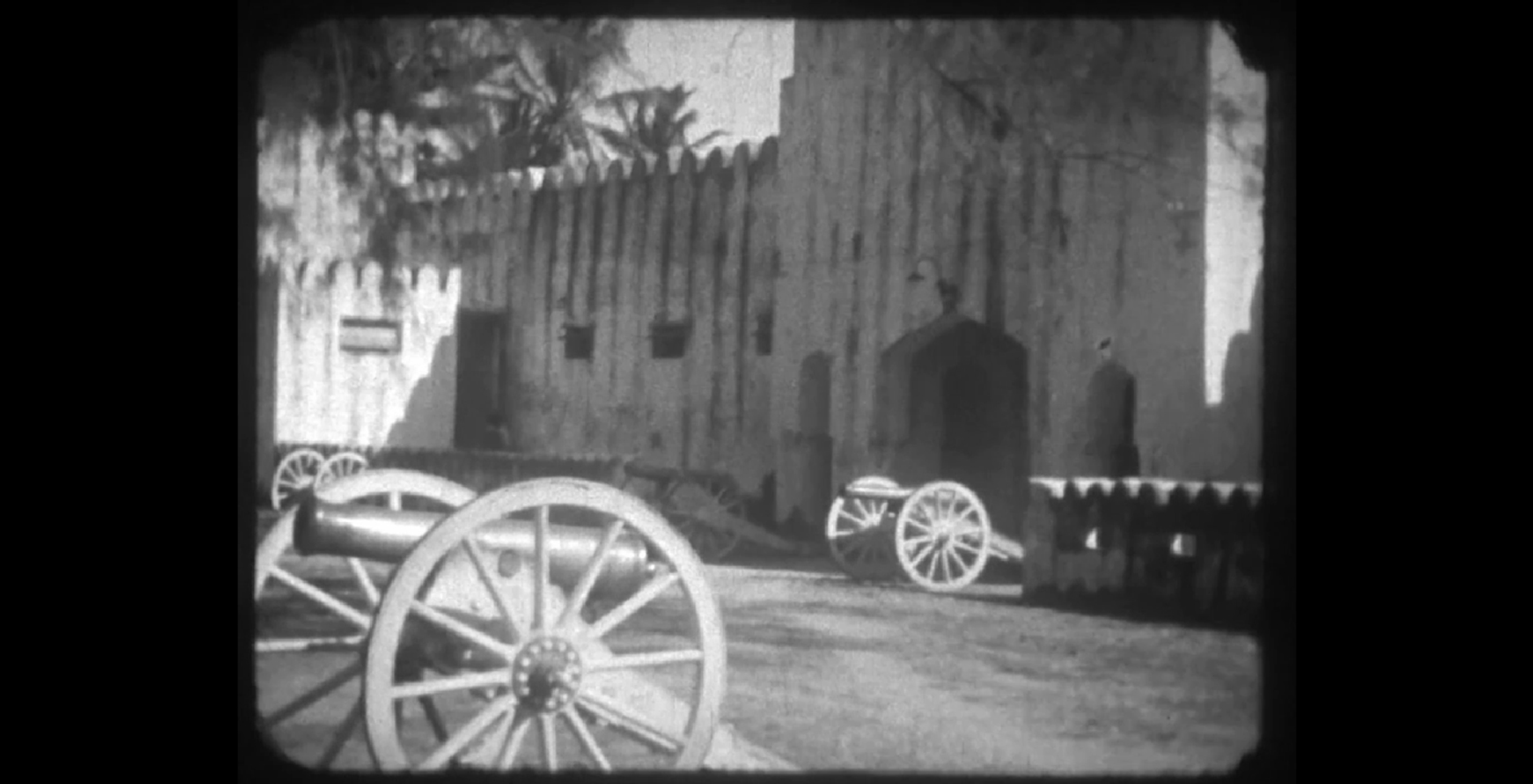
The next point of interest (0:02:57) is the Old Fort, also known as the Arab Fort—one of the oldest structures in Stone Town. It was built by the Omani Arabs in the late 17th century, following their expulsion of the Portuguese. Over the years, it has served as a garrison, prison, and railway terminus. Today, it functions as a cultural centre and tourist attraction, hosting events such as the Zanzibar International Film Festival.
 |
|
The Old Fort, also known as the Arab Fort, in Stone Town - one of the oldest structures in the city. The fort was built by the Omani Arabs in the late 17th century, following their expulsion of the Portuguese. |
Viewers are then treated to footage of what appears to be a local athletics meeting, with an old fort in the background. Despite our best efforts, we could not definitively identify the location or name of the fort seen at 0:04:19. Perhaps our readers can help?
Next, we follow our travellers through the streets of Stone Town (0:04:41), known for its narrow alleys, bustling markets and rich cultural heritage. In the 1920s, it was a vibrant hub of trade and commerce, reflecting African, Arab, Indian and European influences.
One particular street scene (0:06:21) stands out. The architecture is a blend of Arab, Persian, Indian and European styles. Signage for “MOLOO BROTHERS & OR” and “N. S. SIMON SILVA & Co” indicates active commercial establishments. According to one source, Moloo Brothers was the largest curio shop in East Africa, selling items such as silk and ivory. The Tanga Trading Company (0:06:56) likely played a role in this economic landscape.
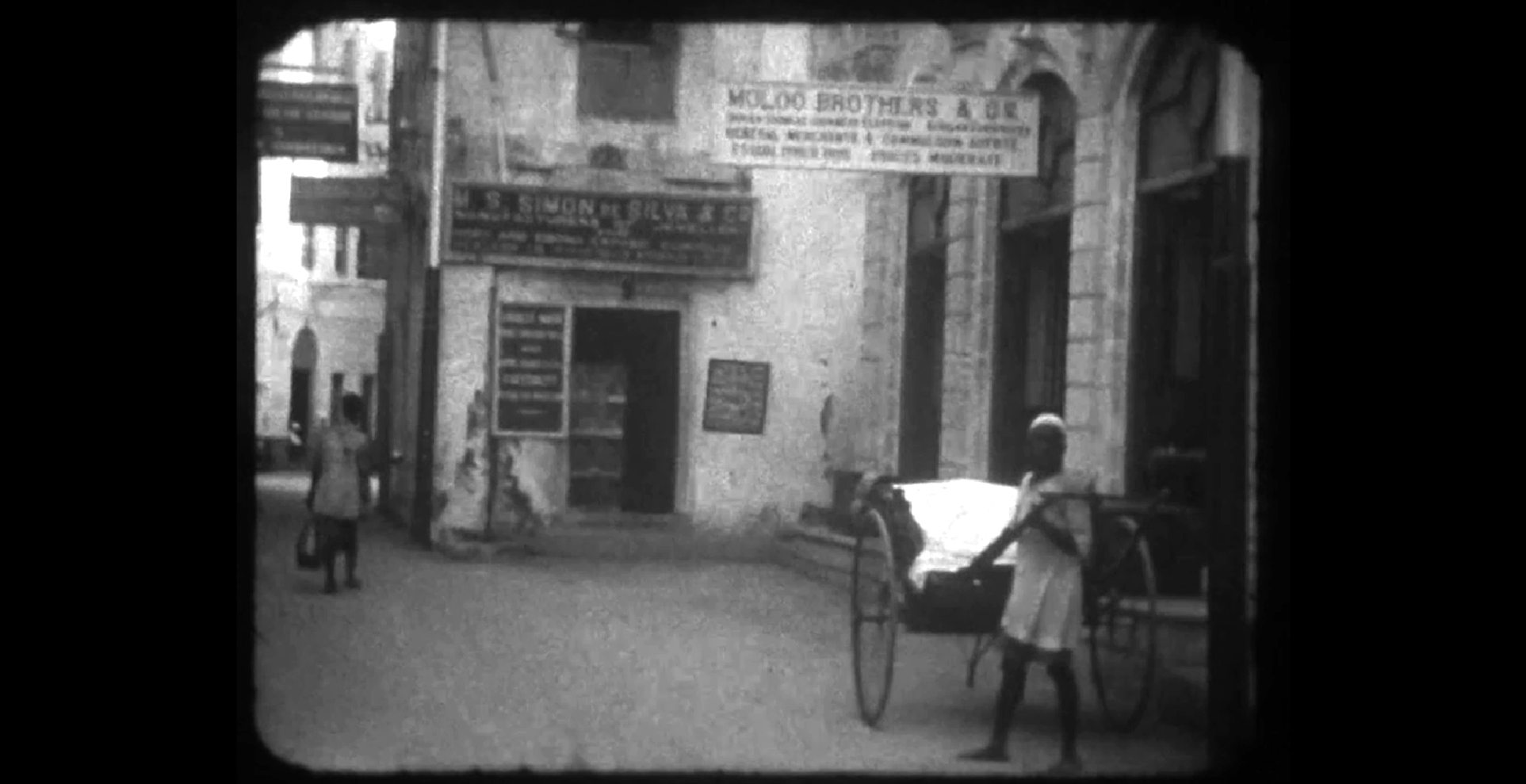 |
| One street scene captured (0:06:21) is of particular interest. According to one source, Moloo Brothers was the largest curio shop in East Africa, selling items such as silk and ivory. |
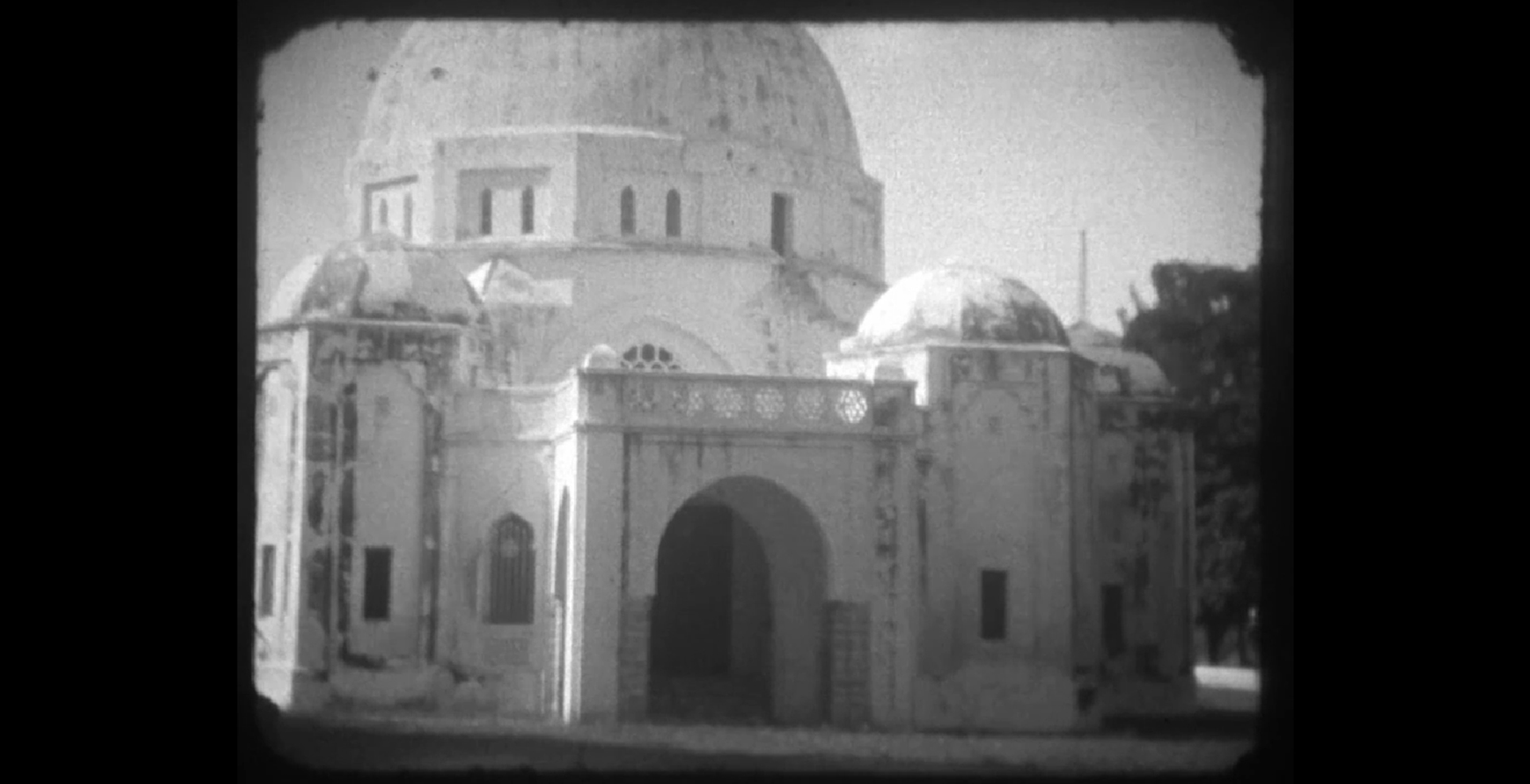
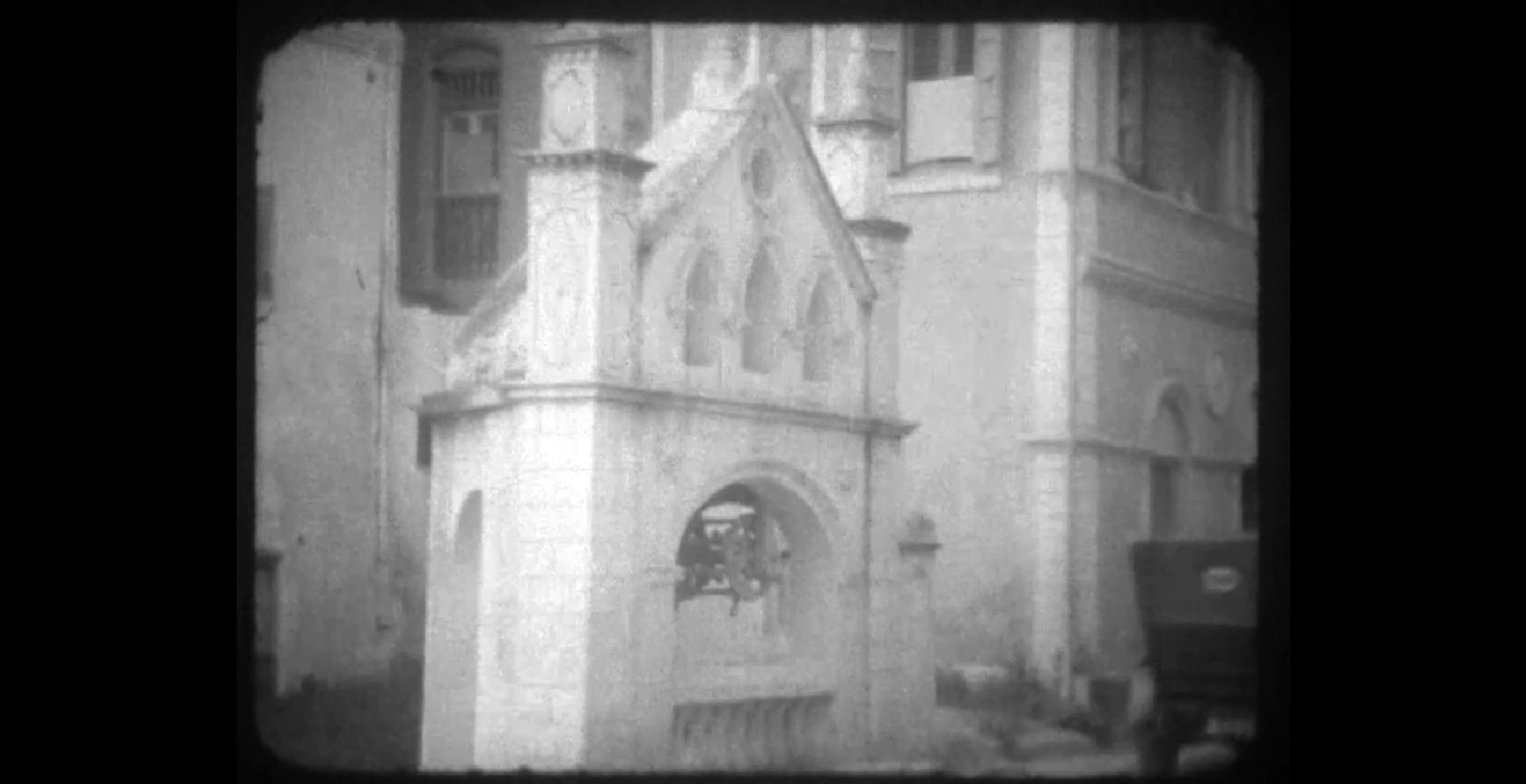
We then fast-forward slightly as Oom Willem travels to Mombasa, Kenya. A definite clue to this is a visit to the Mandhry Mosque (0:08:08–0:08:10), one of the oldest mosques in continuous use in Mombasa, with a foundation date of 1570/71. Rebuilt several times, its oldest existing parts date from around 1830. The mosque is a significant example of Swahili architecture, blending Arabic and African design, and remains an important religious site for the local Muslim community.
 |
|
We then fast forward a bit with Oom Willem travelling to Mombasa, Kenya. A definite clue to this is a visit to the Mandhry Mosque (0:08:08 – 0:08:10). It is one of the oldest mosques in continuous use in Mombasa, with a foundation date of 1570/1. |
Our travellers then visit the Old Port of Mombasa (0:08:25), on the northern side of Mombasa Island. This historic port dates back to pre-colonial times when Arabian dhows would dock here. It is one of Africa’s oldest surviving harbours and was used for trade with other African cities, the Persian Empire, the Arabian Peninsula, India and China.
It is evident that the Van den Berg party had a keen interest in history, as they also visited Fort Jesus (0:12:05), a 16th-century Portuguese military fort designed by Giovanni Battista Cairati and built between 1593 and 1596 to protect Mombasa’s port. It remains a well-preserved example of Portuguese military architecture from that period.
Next on the itinerary was Kenya’s first High Court building in Mombasa (0:12:16). The first British court was launched in a warehouse near Mombasa Old Port in 1890 by the Imperial British East Africa Company. In 1898, it moved into the old police headquarters opposite the entrance to Fort Jesus.
The Imperial British East Africa Company played a major historical role in the 1920s Kenya. Also seen in the home movie is the statue of Sir William Mackinnon (0:12:19) in Mombasa. Mackinnon formed the British East Africa Association, which promoted the formation of the company. £250,000 was subscribed, a charter was granted, and the Imperial British East Africa Company was formally incorporated on 18 April 1888, with Mackinnon—who had subscribed to 10% of the shares—as chairman.
Our second home movie concludes with a visit to Treasury Square (0:12:37), now known as Garden Square. In the 1920s, it was a notable location, serving as the endpoint of Mombasa’s first trolley route, which began at Government Square and passed through Mbarak Hinawy and Fort Jesus. It was also known as a marketplace and was named after a former administrator of the Imperial British East Africa Company.
The final clip (0:13:12) shows traders loading elephant tusks onto boats. As the ivory trade is now prohibited, this scene truly reflects a bygone era.
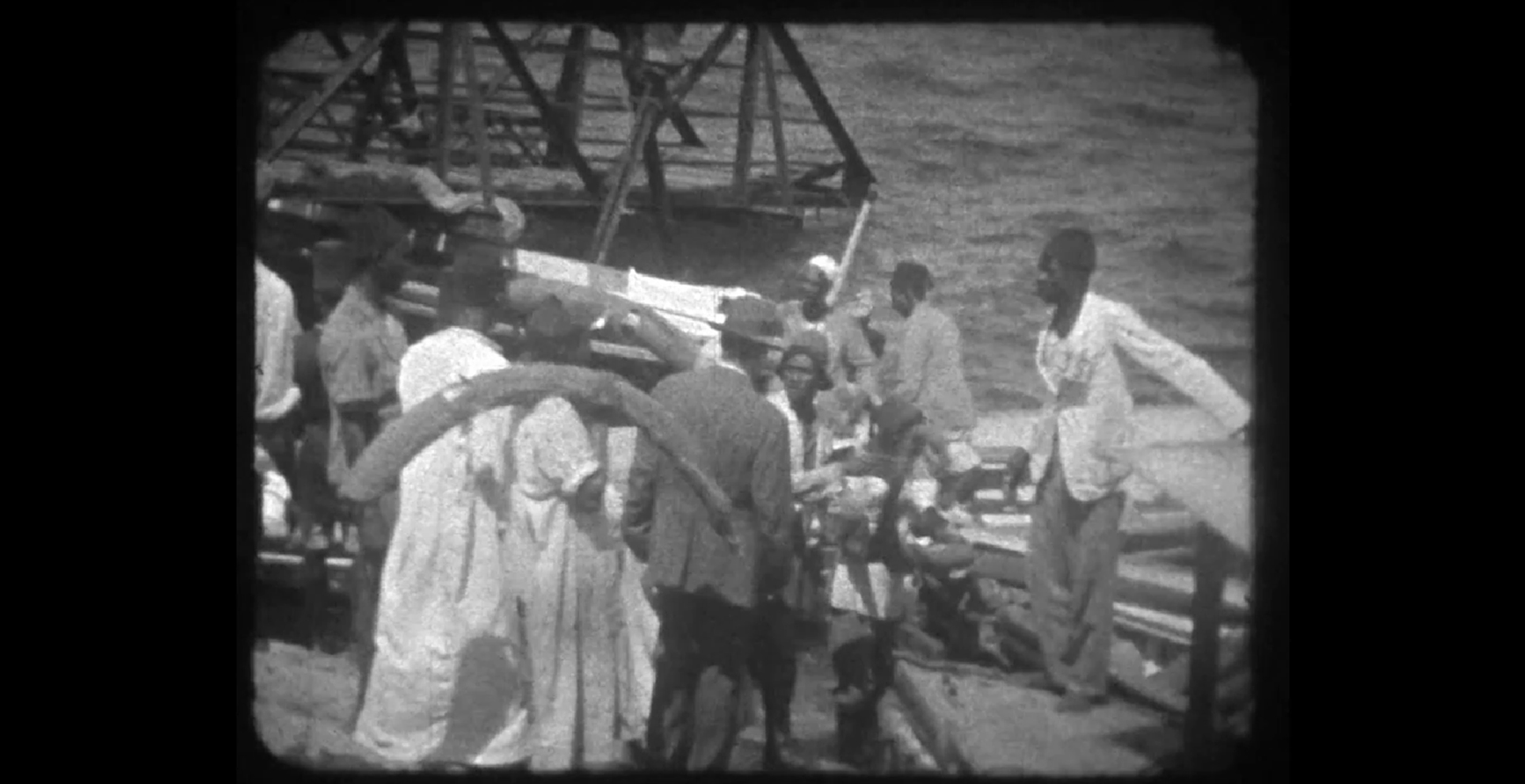 |
| Some of the last clips depicts traders loading elephant tusks on boats. With the trade in elephant tusks now prohibited, this final moment of the movie truly reflects a bygone era. |
That wraps up our second tour recap for this week. Be sure to watch the third reel in our series about Oom Willem’s travels up the East Coast of Africa by scanning the QR code provided with this article. Where will he be heading next? Can you identify the places he’s visiting? Any bits of information can be sent to andries@zoutnet.co.za or WhatsApp him on (082) 603-2419.
EPISODE 3 - Further up the East Coast, into the Suez canal
Viewed: 3201

Andries van Zyl
Andries joined the Zoutpansberger and Limpopo Mirror in April 1993 as a darkroom assistant. Within a couple of months he moved over to the production side of the newspaper and eventually doubled as a reporter. In 1995 he left the newspaper group and travelled overseas for a couple of months. In 1996, Andries rejoined the Zoutpansberger as a reporter. In August 2002, he was appointed as News Editor of the Zoutpansberger, a position he holds until today.
Most Read Articles
Sponsored Content
Recent Headlines