

ADVERTISEMENT:

Search for a story:
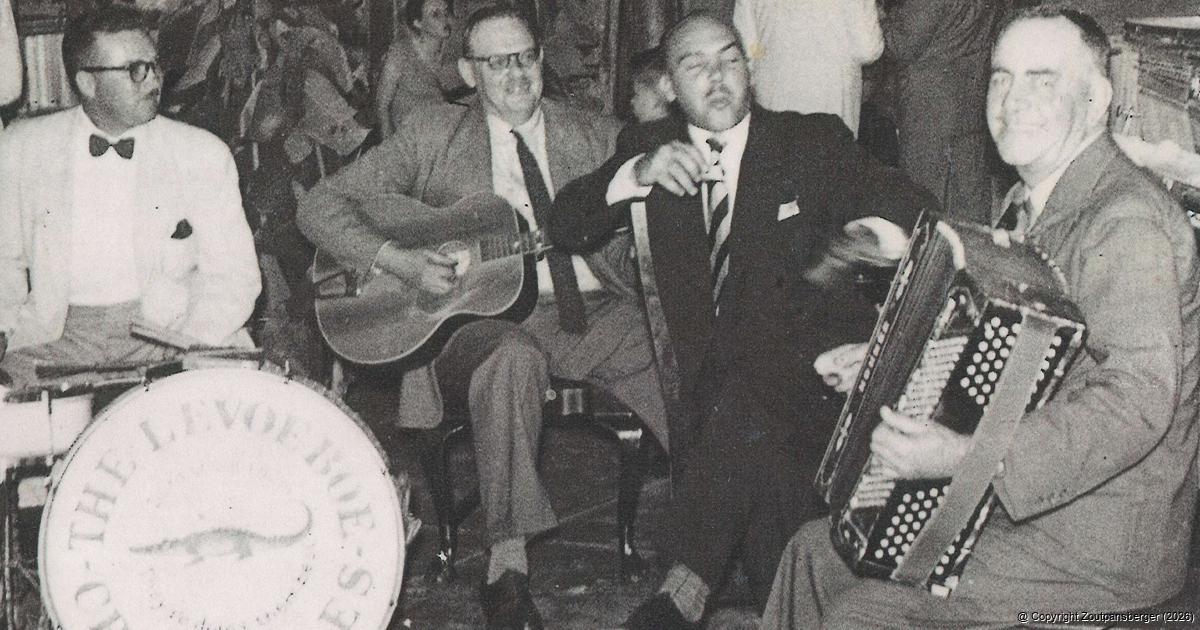
The Levoeboe Crocodiles band. From left are Barney Wessels (drums), Willem van den Berg (guitar), Tommy Woolls and Piet Adendorff (piano accordion). The ‘logo’ of the band was painted by Willem van den Berg and their slogon was: “Don’t shoot them, they’re doing their best!”
Let's embark on a tour with Oom Willem van den Berg
Date: 24 May 2025 By: Anton van Zyl
We invite all our readers to embark on a tour with us that will last several months. During this tour, we will visit several towns and cities in our country and sail up the east coast of Africa. Some of the more exotic locations we will visit include Zanzibar, the Swiss Alps and Vienna. We will be driving really old cars and visiting even older sites.
This is, however, no ordinary tour. For starters, you don’t have to leave your home, as it is mostly a virtual journey. Our “tour leader” was born in 1902 and died more than 40 years ago. Although we will be joining him, it will be through the home movies – some dating back to 1926 – that he left behind.
Our readers are also invited to take part in the tour. Should you recognise some of the places, please let us know and share any snippets of information you may have. This will all be included in next week’s column, where we will describe the previous week’s trip in more detail.
Background
Earlier this year, we received a very interesting “gift” from two Louis Trichardt residents, Susan and Irene Adendorff. Their grandfather, Piet Adendorff, farmed in the Levubu area, near where the Albasini Dam is. A good friend of his was Willem van den Berg, a Dutchman who arrived in the Soutpansberg in the early 1930s.
Willem van den Berg was a very interesting character (more about him later), and one of the first people to experiment with 16mm film. As far back as 1926, he began making movies about the trips he and his family and friends took – firstly in South Africa, but then also in other parts of the world. He was also very fond of showing his movies to visitors.
After his death in 1984, the two trunks containing the film reels were mostly abandoned. The farm was sold, and some of his belongings went to his goddaughter. When she passed away, the trunks ended up with the Adendorff family, who had been friends of the Van den Bergs for decades.
Susan and Irene Adendorff realised that the films might have historical value, but the cost of converting such reels into digital format is prohibitively high. Many of the films were also in extremely poor condition and had started disintegrating after so many decades.
The Zoutpansberger was then approached to see whether we could assist in preserving the films. The newspaper hosts one of the largest historic camera collections in the province, with over 200 cameras on display – the oldest dating to 1887. Although there are some 8mm movie cameras, most of the cameras on display were used for still photography.
Unique solutions to shine a light on treasures
When the first “movie” films appeared in the 1890s, they were shot on 35mm celluloid film strips. In 1923, the Eastman Kodak company introduced 16mm film as a more affordable and safer alternative to 35mm, aimed at amateur filmmakers. In 1932, the market shifted to the cheaper 8mm film, which became the benchmark for home movies until the 1970s, when formats like VHS and Betamax became popular.
What makes the Van den Berg reels so intriguing is that he began capturing footage when the technology was still in its infancy. The reels likely contain some of the first films ever made in the regions where he travelled.
The team at the office was fascinated by the reels. The first challenge was how to convert them into a format that could be accessed. As luck would have it, someone donated an old 16mm projector to the newspaper’s camera museum a few years ago.
The projector needed some work. The gears were cleaned, and the clutches rebuilt. Since the projector globes were no longer available, the light source was converted to an LED lamp. The movies were projected onto a small screen and digitally captured with a separate video camera.
Unfortunately, about half of the reels could not be rescued with the technology available. Many of the films had absorbed moisture over the years, causing them to curl and shrink. These were too brittle to run through a projector.
We grouped the 17 films that could be saved into “themes”. The oldest dates to 1926, with a cryptic inscription on the reel stating it was taken in the Barberton area. Around 1927 and 1928, Van den Berg took part in two “Auto Tours” in Europe. In 1929, he may have travelled from Johannesburg’s train station all the way to Genoa, Italy, via Africa’s east coast. In between, there were tours to what is now Namibia, the Western Cape and Natal.
Who was Willem van den Berg?
Based on what we could gather – mostly thanks to the Adendorff sisters – Van den Berg was born in Amsterdam in 1902. He was slightly younger than their grandfather, Piet Adendorff, but the two often toured together and were part of a local band called the Levoeboe Crocodiles.
Piet Adendorff was very concerned that parts of the region’s history would be lost as older people passed away, so he interviewed them and recorded the conversations. Irene Adendorff helped to transcribe the interview with Willem van den Berg, from which some of this information is drawn.
In the interview, he explains that he wanted to settle in South Africa but first decided to get a diploma at an agricultural college in England. He completed the course in 1923 and arrived in South Africa in 1926.
“I went to a big cattle ranch in the Western Transvaal that belonged to a Norwegian company, and I worked there for about nine months. Then I heard about two Hollanders, Van Beek, who had a farm in the Free State, and they were breeding Afrikaner cattle,” he told Piet Adendorff.
In the interview, he does not say how long he worked on the farm Wintersvlei in the Free State, but it must have been about two years. Some of the footage is marked “Wintersvlei” and shows scenes of cattle farming. He also met his wife, Jo, in the Free State. She was the sister of Dick Koker, who worked with him on the farm. The wedding took place in Holland, at the insistence of Van den Berg’s father.
The couple settled in the Soutpansberg around 1930, where he bought the farm Palmaryville. The farms were later bought by the government and subdivided into smaller units to promote agricultural diversity. Van den Berg then settled on a property near the Albasini Dam. When World War II broke out, he was recalled by the Netherlands Army and trained at Wolverhampton in England. He spent part of the war in the Merchant Navy, supporting Allied operations across multiple continents.
When he died in 1984, he left some of his belongings and his property to the MOTHs’ Turbi Hills Shellhole in Louis Trichardt. He and his wife had no children.
But let’s begin the journey
Over the next few months, we’ll be looking at the 17 film reels. Each one is unique and packed with gems from the past. Some of the historic buildings he filmed no longer exist. While his home movies were made during the colonial era, they did not focus only on the elite. Some scenes depict a wedding in rural Natal, while others show a snowy car trip through the Alps.
Car enthusiasts will enjoy the footage showing a 1929 Buick stuck in the mud, being towed from a river, or getting (yet another) flat tyre. There are Ford Model Ts, Dodge Brothers vehicles, and possibly even a Rolls-Royce.
Each week, we will also share stories Willem van den Berg told about the area – especially his visits to the Kruger National Park.
Most of the space will be dedicated to the journeys. We’ll publish screen grabs from the various destinations, sharing insights about each. But we’re counting on our readers to assist – by identifying places and adding context to what they see.
Any bits of information can be sent to us at andries@zoutnet.co.za or you can even WhatsApp it to him at (082) 603 2419.
Click here to view details of the first tour
Viewed: 2543

Anton van Zyl
Anton van Zyl has been with the Zoutpansberger and Limpopo Mirror since 1990. He graduated from the Rand Afrikaans University (now University of Johannesburg) and obtained a BA Communications degree. He is a founder member of the Association of Independent Publishers.
Most Read Articles
Sponsored Content
Recent Headlines